.png)
Bitcoin has become a core treasury holding for institutions, yet deploying it on-chain has usually meant handing it to a new counterparty and commingling funds with other users. Verifiable Bitcoin Accounts remove that trade-off, so an allocator can access on-chain markets while their Bitcoin stays fully segregated and attributable.
Unlocking A Trillion Dollar Market
Bitcoin-backed lending reached $73.6 billion in 2025 and is projected to exceed $90 billion by the end of 2026. That lending is funded largely by stablecoin liquidity, a market that reached $308 billion in early 2026 and is on track to exceed $1 trillion. Institutional Bitcoin holders sit at the intersection of both trends.
Ernst & Young, in a January 2025 survey conducted with Coinbase, polled 352 institutional decision-makers, each overseeing $1B+ in AUM, about their primary barriers to deeper crypto integration. The top three responses were an uncertain regulatory environment (52%), volatility (47%), and security of asset custody (33%). Among the subset that has no plans to engage with DeFi specifically, the barriers shift, with regulatory issues (57%), compliance risks (55%), and lack of internal knowledge (51%) leading the list.
The constraint has never been demand. Institutions have been waiting for a deployment model that works within the custody arrangements, tax regimes, and legal frameworks they already maintain and does not force them to rebuild their risk controls.
Verifiable Bitcoin Accounts are built to close that gap.
What a Verifiable Bitcoin Account Is
A Verifiable Bitcoin Account reserves an institution's own Bitcoin. The coins are set aside in their own designated position on the Bitcoin blockchain, never pooled with anyone else's, and a liquid representation, tBTC, is issued against them for deployment in on-chain markets. Only the account address controlled by the owner can redeem or extend the position, and redemption returns the same coins that were reserved. Anyone running a Bitcoin node can verify it all, which is what makes the account verifiable.
Your Custody, Your Terms
A Verifiable Bitcoin Account runs from the custody setup an institution already operates. The Bitcoin stays fully segregated and attributable.
The institution sends a single Bitcoin transaction to fund the account and signs from an Ethereum account within the same custody stack it already uses. Nothing about the existing setup has to change.
How The Position Moves: Custody To Reserve To tBTC, And Back
The coins are reserved as their own identified UTXO(s), never pooled, and tBTC is minted against that reservation to an address named by the owner. When the position is redeemed in kind, the same coins return.
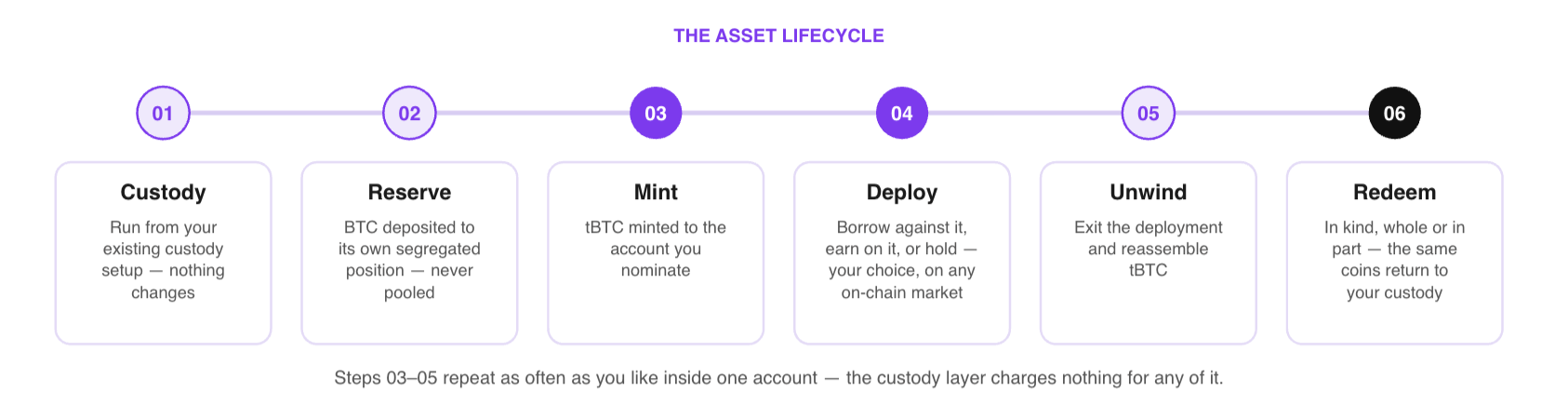
What the tBTC does is entirely the owner's choice, since it can go into any venue or stay idle while the reserved Bitcoin remains unaffected by what happens to the tBTC.
Redemption, Plainly
Redemption is in kind. It can be taken in whole, or in part and repeatedly, at any time strictly before expiry, to a Bitcoin address the owner.
Supported destinations: P2PKH, P2WPKH, P2SH, and P2WSH. Taproot is not currently supported.
Redemption settles across several steps rather than in a single transaction, so exits should be planned against the term rather than against the clock on a given day. A partial redemption pays out the redeemed portion, and the remainder continues as a smaller account.
Verified, Not Just Trusted
Institutional adoption of Bitcoin in on-chain markets does not scale on assurance alone. It scales on independent verification. Every element of a Verifiable Bitcoin Account can be verified by inspecting the anchor UTXO and the on-chain ownership record, and the position's full lineage is provable by anyone running a Bitcoin node.
"Institutions don't need additional layers of trust; they need systems where outcomes are defined and verifiable from the outset. By providing a segregated, compliant, and tax-advantaged pathway to on-chain finance, tBTC aligns Bitcoin with the standards institutional capital actually requires." — MacLane Wilkison, Co-Founder of Threshold Network
Verifiable Bitcoin Accounts set a standard for institutional Bitcoin deployment in which every component of the account can be verified before a single satoshi is committed.
Where This Stands
Not live yet. Verifiable Bitcoin Accounts are pre-deployment, and the first live position depends on steps governed by the protocol.
The full diligence pack, led by the custody-and-control brief that cites the code governing every claim above, is available on request.
Request the Diligence Pack
Verifiable Bitcoin Accounts are available to qualified institutional participants. Talk to our institutional coverage team to get started.

.png)